Showing posts with label food. Show all posts

Sunday, June 11, 2023

Book Review: How To Taste by Mandy Naglich


I saw a television programme about chocolate tasters when I was a kid. It was a revelation for me that instead of going to an office or shop or doing farming, a person can sit and eat chocolates for the whole day and get paid for doing it. As teenagers, we used to make jokes about the lives of wine and whisky tasters. We used to imagine them in a state of perpetual inebriation. Some years ago, the documentary on wine tasting certification titled Somm rekindled my interest in tasters. I was enamoured by the participants descriptions of the notes of different wines in poetic terms. At the same time, I had this notion in the back of my head that all these claims of identifying the taste of polished leather or the vineyard that made the wine were global frauds and part of a branding attempt. But reading the upcoming book How to Taste has dispelled my notions to a large extent.

How To Taste, the book by Mandy Naglich, who is an advanced Cicerone (a certification for beer tasters) and a certified tester, comes with the tagline "a guide to discovering flavour and savouring life" and is an attempt to demystify the art of tasting for the layperson. The book tries to differentiate between eating something and tasting it. It has to be similar to the difference between seeing something and watching it. When I was a kid, there was an exhibition of medicinal plants at my school. One of the plants was called Chakkarakkolli (Gymnema sylvestre or Madhunasini), and eating it would make us unable to taste sweetness. I, along with a friend, ate its leaves and then tasted a candy. We were terrified, as the sweetness was totally missing from the candy. We drank plain soda to remove the effects and then, much to our relief, gained back our taste. Though we ate the candy, we weren't able to taste it. So there is a difference.

The first part of the book explains the mechanics of tasting. Taste is a sensation, and like other sensations, it is the work of our nervous system to make us experience it after collecting the necessary stimuli through our taste buds. This part provides a step-by-step description of the process. It also illuminates how other sensations like smell, sight, and sound influence our tasting and how the process itself is a symphony that, when rightly done, can provide an experience to cherish for a lifetime. Like in the case of any other sensation, there are people with different capacities for tasting, like supertasters, who are capable of identifying minute nuances of flavour in foods and drinks.

The second chapter lists the best way to extract the full benefit of the tasting experience by using seven steps. There are tips to enhance and complement the visual, auditory, and, most importantly, olfactory elements of tasting. There are important roles that temperature, wall colour, ambient sounds, and smell play in tasting. For example, a red wall can enhance the sweetness of your ice cream, or gently warming your olive oil can enrich its texture and aroma. We come to know the significance of swirling the wine or sniffing the cheese, practises that we have seen countless times performed and parodied on social media.

Part three of the book provides the reader with an introduction to the tasting profession, including certifications, competition, awards, and grading systems that hone the skills of professional tasters, help entrepreneurs upgrade their products, and establish and update new skills in the culinary world. There is a chapter on food pairing and another that helps to describe the sensual and emotional experience of flavours in precise words. In Part 4, the author writes more about how skills acquired as a taster can improve general experiences of life. Travelling to a strange destination can be used to acquire new additions to the flavour collection. Flavours trigger memories and connect the taster to the past. So new flavours can be used to imprint long-lasting memories in the brain.

How to Taste is a book that can help a reader start tasting instead of simply eating. It is an information-filled journey that the reader will find useful to implement practically in life. Personally, I found the writing in certain portions a bit too technical and jargon-filled for my liking. As an Indian with minimal exposure to global specialty cuisine and fine dining culture, there are many descriptions that I cannot relate to. But the practical tips, the many dos and don'ts of tasting, and the expertise and experience of the writer that translate into her writing made reading this book worth it.

Inexcusable are the numerous typos, insertions of wrong words, and instances of weird sentence formation in the text. I agree that what I received was an ARC, and the final book may be released with corrected text, but all these faults seriously impaired the overall experience.
Saturday, June 20, 2015

A long and mostly pointless rant on food.

Some days back I saw a news report on a television channel that compared the vegetable prices in different parts of Kerala. The reporters purchased vegetables worth Rs.100 from a border village in Palakkad. They travelled with it to Thrissur and enquired in a wholesale shop about the cost of same amount of vegetables. It was around Rs.180. At Ernakulam, the price of Rs.100 worth of vegetables from Palakkad was Rs.280!

For some days I couldn’t help thinking about various aspects of this information. Most of the vegetables that are consumed in Kerala are cultivated in Tamil Nadu. That explains the cheap rate in border areas. The cost increases as the produce travel more distance. What may be the reason for this difference? Transport cost obviously. Just that, or is there more to it? What about the risk factor involved in transporting products of lower shelf life that may get spoiled by the time it reaches end seller? And what about the extra care to preserve them- an extra dose of pesticide or refrigeration? In that case, what about the additional risk on the health of consumers?  Is there any other social reason for the price in Ernakulam to be so high; may be the fact that it is a more developed city than others?

One solution that I could think of was reducing the time taken for transporting the produce, thereby reducing risk of spoilage. The obvious solution is to invest in infrastructure. Better road connectivity between towns can reduce shipment time. If good highways are made in which vehicles with heavy load can safely travel at high speeds, more goods can be transported in lesser time. Instead of transporting small quantity of goods in old worn out trucks, an efficient collection system can be put to place that aids in amassing huge quantity of produce and they can be shipped using improved fuel efficient carrier vehicles with refrigerated containers. Though the cost of investment in all these setup will be passed on to the end users, after a certain period of time this may prove beneficial.

On further thoughts, I felt that there can be another alternative, one which can totally eliminate or reduce considerably the need to transport vegetables. It is by local production and distribution, which was the way things were sometime back. At present, in between the farmer and buyer, there are at-least four agents. Firstly collection agents purchase goods from farmers and sell it to the distributor. The distributor dispatches it to wholesale merchants of different cities. The wholesale merchants receive them and divide it for distribution in different areas in their respective localities. Ultimately the retailers who get the load from wholesalers sell the vegetables to the consumers. This system adds on the overheads and risks of all the involved agents into the picture, thereby increasing the price of the goods substantially by the time it reaches end consumer. Inventory cost and transportation cost add on the final selling cost along with the expense of extra processing for preservation.

An alternative to the existing system is, as I mentioned before, to produce and distribute groceries locally. For that purpose primarily people has to be given motivation to cultivate products that are necessary for their consumption in their backyard or balconies or terrace. This is in-fact happening in many households already. I have seen people purchasing cauliflower and capsicum ignoring papaya and jackfruits growing abundant in their own backyard. The problem is we all need exotic food. In a recent past it was a luxury, but now it is the norm. If a mother makes papaya curry for two days, kids and husband start protesting the next day. They demand for something different and exciting daily. We eat Chinese, Italian and North Indian cuisines, but forget our healthy ancestral dishes that can be made with ingredients that grow or can be easily grown in our backyard. There are eateries that sell local dishes but they charge a premium. Locally cultivated, organic vegetables can be purchased from market but at a premium rate.

It is this situation that needs a change. Every household has to be trained to cultivate some part of their diet taking into account their space constraints. Also support has to be provided to market the excess crop left over after consumption at the local market in a cheap rate. This gives additional income to the growers. Indigenous food products and dishes have to be promoted and their health benefits explained. This motivates people to purchase them and support the local market. Processed food should be manufactured and marketed only locally so as to reduce the need of preservation. Elimination of preservatives reduces the use of chemicals and ultimately contributes to a healthy society. Cost of the produce reduces dramatically as the transporting overheads and risks are considerably reduced. As everyone is at the same time a producer and consumer, society becomes more interactive and closely knit.

But who will tie the bell on the cat?

Friday, November 21, 2014

Eating Competition

I went with my giant friend to have tea. At the tea shop, he took one pazham pori and started eating. I too took one and ate.

He took one more and ate. I followed him and had one too.

Then he took a puffs and devoured it. I grabbed one for myself.

He claimed that the combination will be right with one more pazham pori and had one. I agreed and took one for myself.

He ordered a strong tea with more milk. I too ordered for same.

After both of us finished our tea, he slowly got up walked to the counter and declared all that he needed now was a sweet lemon soda. I surrendered.

Tuesday, September 23, 2014

Indian Takeaway- In Search of an Identity...

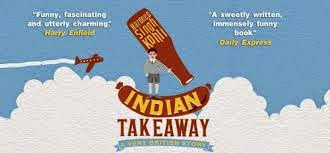
Last year I happened to read an incredible book by Monisha Rajesh in which the British Indian journalist goes on a journey through the length and breadth of India in trains. It turns out to be a self revelatory experience. Now this 2008 book, Indian Takeaway is much similar. Here, a Scottish journalist of Indian origin, an amateur cook, travel across India cooking British food for locals. He does it in the belief that this exercise can reveal his true identity.

Hardeep Singh Kohli is a journalist and TV personality. He is also an amateur cook. He was brought up in Glasgow by his immigrant parents. In his childhood, to his surprise, he was treated as an outsider due to his Indian ancestry. But his views, interests and allegiance were very British. This duality made him undertake a journey through different cities of India, and cook a British dish at each city. Read the book to find out if anything comes oyt of this exercise.

First thing that strikes the reader about this book is the honesty that the writer brings on the table. About his feelings, cooking, family, culture, things he sees and has to undergo on course, Kohli writes openly. There is an incident in the book where he is not sure about his train reservation and worries about journeying in third class. Any other person would have sugar coated the whole thing, but Kohli doesn't. He openly declare his fear of 'the girl who is eating mango and the old woman who sleeps on floor'. At first I felt it insensitive, but who am I to judge!

Second best are his descriptions- about journey, places, people and more importantly about food and cooking. He masterfully builts up the atmosphere, so that the reader finds it easy to understand his thinking. There is a liberal dose of humor sprinkled in the narrative. Some of it works, but some falls flat. Certain anecdotes and attempts on word play, doesn't gel with the content of the book. Another major issue for me was 'the Kohli Family Trivia' which severly hampers the flow of the book in many places.

Overall I felt it to be an interesting read and may be of interest to foodies and travel enthusiasts, though the final outcome, whether Kohli was able to find out who he really is, turned out to ambiguous.