Wednesday, July 10, 2013

Dongri to Dubai: Six Decades of the Mumbai Mafia by S.Hussain Zaidi

The underworld of Mumbai and its modus operandi are familiar to people outside Mumbai through newspaper reports, crime features in media and many gangster flicks churned out regularly by Bollywood and other film industries of the subcontinent. Dongri to Dubai is an attempt by veteran crime reporter Hussain Zaidi to chronicle the birth and rise of the monster that is Mumbai mafia in the past six decades. As the key player of the game is Dawood Ibrahim, it is just natural that his story occupies the major portion of the book. Even the title mentions his rise from a small time law breaker in Dongri to the kingpin of an international enterprise indulging in several illegal activities with its pivot in Dubai and its tentacles spread world over.

The book starts with a telephone interview that the writer had with Dawood, which in itself is a rarity and a priceless scoop as the Don is rather reluctant to come out in public after the infamous blasts. Even any of his recent photographs are not available in the public domain. The story then go back to pre-independance years and describe the formation of several small gangs operated by immigrants from North India. After detailing the plight of many minor gangsters and their eventual fading into oblivion, caused by fighting among themselves or by the long hands of law, we read about the rise of one man who is responsible for the first criminal empire in Mumbai- Haji Mustan. Mustan, who used to be a coolie on the docks, took up smuggling for the extra monetary benefits. Soon he built links with Gulf countries and graduated to an established gold smuggler. The other two gangsters who joined hands with Mustan to form a troika of money, muscles and network were Varadarajan Mudaliar, the South Indian illegal hooch king and Karim Lala, the powerful leader of Pathan gang.

Ibrahim Kaskar was a police constable who maintained good relation with all major gangsters. His son Dawood clashed with Pathan gang and was aided by Bombay Police to form his own gang and quash the Pathan power. Police wanted to use Dawood for their own aid, but he had other plans and was using police support for his own benefit. Soon gang wars raged on the streets and Dawood emerged the lone survivor, sidelining even Mustan and Karim Lala. After the Bombay blasts, Dawood and his aides had to leave India. Still his clout was maintained and Mumbai mafia was remote controlled from Dubai. Fallout between Dawood and Chhota Rajan, how Dawood ended up in Karachi and the relationship of Bollywood and D company are the other major episodes in the drama.

Dongri to Dubai has an exhaustive subject scope with lot of details. The writer should be given full credit for exploring it with such passion and vigour. He covers a lot of ground and yet manages never to bore or confuse the reader throughout the narrative. The language of street with liberal sprinkling of expletives adds the authenticity. For those of us who are aware of many incidents and characters described in the book, it serve as kind of a solved fill in the blanks puzzle. The revelation of motives and hidden agendas behind incidents that are embedded in psyche through newspaper reports (like the attempt on Chotta Rajan's life or Chotta Shakeel's innings in Bollywood that ended in a debacle) were interesting to say the least.

One issue that I had with the book is its attempt to sensationalise the issues. The description sometimes descends to tabloid quality. Also the human angle is never presented, causing the narrative to never rise above the level of a nineties Bollywood revenge thriller. Also the writer describe the links between mafia and film industry in length, but surprisingly is quiet about its connection with cricket. Nowhere the name of a cricket player is mentioned. Inspite of these, Dongri to Dubai is a wonderful book. It serves as a compelling and necessary read for all, as terrorism and mafia is engulfing our ordinary lives in many different ways. For example it was shocking for me to realize that the profit from selling of pirated DVDs in the subcontinent is used for funding terrorism! No more grey market DVDs for me.

Friday, July 5, 2013

The Number One Ladies Detective Agency: Flavor Botswana

The Number One Ladies Detective Agency: I am not sure why I picked up this book to read! From some time I had noticed the books of this series on the shelves of my friendly neighborhood library and many book stalls. I am always reluctant to choose a book that is part of a series. Still I chose The Number One Ladies Detective Agency by Alexander McCall Smith. May be I needed a relaxing and easy read then, which the cover art of the book promised.

The story is set in Botswana. Mma Precious Ramotswe is the proprietor of the country's (probably even whole Africa's) first private detective agency run by a lady. After escaping an abusive marriage, she sets up her agency with the help of an inheritance. Initially no many clients approach her but soon business improves thanks to her sharp intellect and sincere approach. She solves many cases involving missing husbands, dishonest teenage kids, fraud imposters and so on. She finds a good friend in the neighboring motor mechanic and feelings start to develop. There is parallel track concerning a missing kid who is probably kidnapped for the purpose of witch craft.

The novel is an easy read. It captures the living conditions and culture of Botswana beautifully. The lead character is the main reason to read the novel. Mma Ramotswe is portrayed as a no nonsense African lady with huge respect for the culture and tradition she had grown up in. She has a very good sense of justice which she uses in her profession to help others. The social conditions of the continent- superstitions, gender bias, cultural differences between several ethnicities, traditions and traditional values are portrayed in a picturesque manner. But if you are looking for a conventional mystery, you are in for disappointment. The pace here is more relaxed and the plot is a bit disjointed. Unlike other detective fiction, this novel does not even have a central mystery for the detective to solve.

I liked the book and would recommend it if anybody wants a light read. But I am not sure if I will ever try the follow up books.

Wednesday, July 3, 2013

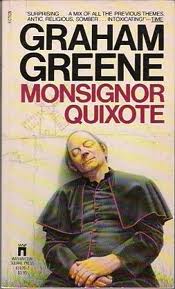
Monsignor Quixote by Graham Greene: On Doubt and Belief

A Catholic priest named Quixote and a Communist mayor named Sancho goes on an adventurous trip on a battered car named Rocinante with a seemingly unlimited supply of wine. This is the one line plot of the short but poignant 1982 novel Monsignor Quixote by Graham Greene. You would have identified the characters by now if you are familiar with Cervantice' classic Don Quixote. Monsignor Quixote is a retelling of the masterpiece in post-Franco (a ruthless dictator) Spain. The novel discuss several topics like religion, politics, love and dictatorship.

Father Quixote, a simple priest who claims to be a descendant of the legendary Don Quixote, serving in a small village is unexpectedly promoted as a Monsignor when he helps a stranded Italian Bishop. His Bishop finds it surprising as he suspects Father Quixote of aiding Communists. At the same time the Communist Mayor of the town, who shares his surname with Sancho Panza, Don Quixote's sidekick, loses his position. Priest and Communist, both on good talking terms with each other decides to use this opportunity for an unplanned trip across the country in Quixote's old, withering car whom he fondly calls Rocinante. The novel describes their adventures on the way which faintly resembles those on Don Quixote's journey, the conversations between them about each others beliefs while downing bottles of wine and finally culminate in the tragic but expected (if you have read Don Quixote) climax.

By making his protagonists believers in two extreme ideologies, Graham Greene very cleverly sets up stage for some thought provoking discussions. At the same time it never gets serious or monotonous but gives the feel of a light banter between thick friends. There are many adventures thrown in between conversations where these friends get entangled with and get themselves pursued by law enforcers. The innocence of the lead character is endearing. There is a situation were he gets in for watching a movie titled Maiden's Prayer inspired by the title and it turns out to be a semi- porno film.

I believe the conversations in the novel between the priest and the communist are actually two voices inside the writer himself. If viewed closely we can find a man torn between beliefs and ideals. There is a nightmare that Father Quixote sees. On the third day after getting crucified, all are convinced that Christ is the Son of God beyond any doubt. There is no resurrection and all Roman generals and Jews gather to make Him ascend the throne. Father Quixote feels that if there is no doubt to anyone that Christ is the Messiah, religion becomes obsolete. Faith and belief survive by hanging on the narrow thread of doubt.

Monsignor Quixote is a novel that is entertaining and enriching simultaneously. Its short and beautifully carved, with characters whom we can identify with and studded with hilarious situational comedy. A definite must read.

Saturday, June 29, 2013

Book Review: The Virgins by Siddharth Tripathi

Graduating from being a boy to becoming a man is the most important event in a guy's life. The path that his later life takes depends on this crucial period. That is the reason why lot of 'coming of age' tales are told in novels and movies. Normally such stories take two routes- positive or negative. Siddharth Tripathi's debut novel The Virgins chose to take a safe middle path.

The Virgins tell the story of three friends- Guggi, Bhandu and Pinku, growing up in Banares. Pinku, a school dropout whose drunkard father is an abuser, leads a poor life. He falls in love with a girl who pointed a gun at him and decides to change his ways. Parents of Bhandu live apart and are on the verge of divorce. He used to be a good student, but his company and his frustrations over the impending separation of parents is making him lose his concentration. Guggi is the spoilt brat who is the master mind behind all schemes that always lands the trio in deep trouble. His biggest intention is to hijack and run the protection racket in his school. Then there are a pack of reckless supporting characters who adds much color to the proceedings. The story deals with how the ambitions of these motley crew gets intertwined.

The narrative beautifully portrays the rugged life in Varanasi. More than the plot (which is almost non existent), the beauty of this novel lies in its narration and characters. The pacing of the novel mirrors the recklessness of the characters. Lot of expletives are filled in the dialogues and it contributes to the authenticity. It takes some time to get used to the slang and atmosphere of the novel, but once you get the hang of it, it becomes enjoyable. The writer never tries to do change the natural flow of the story by involving any motivational element, nor does he makes the whole ending tragic, which is the usual norm in such stories. The climax is unexpected and chilling. It makes the reader to think back and re-evaluate the motives of characters. There are several laugh out moments studded in the narrative. Only minus that I can think of is the presence of several subplots that eventhough well written, just don't gel with the main plot.

Siddharth Tripathi has written a good debut novel and overcomes its incoherent plot with well developed, realistic characters and a galloping narrative. Its worth a read.

Publisher: Fingerprint!
Cost: 250
Source: Review copy by author.

Thursday, June 27, 2013

Lamb: Gospel According to Biff

Lamb: The Gospel According to Biff is a humorous mythological novel written by Christopher Moore. Before proceeding, a word of caution. This book may offend you. It may offend you big time, because this novel tells the story of Jesus Christ, it liberally deviate from the Scripture and it portrays a Son of God who is never reluctant to enjoy a light moment even in severe adversity. This novel may offend even those who are not Christians as there are several references about Buddhism, Hinduism and Judaism, and not all of them in a flattering way. The novel is about the formative years of Jesus. It is about that decades of his life which is never mentioned in any of the written gospels.

The novel starts when a man is awaken from death by an angel in the contemporary world. The man is revealed as Levi aka Biff, who was the intimate friend and companion of Jesus, but never getting a mention in any of the written gospel. The angel takes him to a hotel room and makes him write his version of gospel. The story proceeds in two levels- through the gospel written by Biff, telling the story of his life with Jesus and his interaction with the angel in modern times. Biff finds about Jesus' (referred as Joshua, the Hebrew version of the name) gift of healing in an unusual way. From that time they become close buddies, doing all the buddy things together. Joshua knows he is the Messiah whom Jews are waiting for, but other than that, he is unsure and confused what to do. Both the friends feels an infatuation with a neighbouring kid, Mary of Magdalene who also joins in some of their adventures together. Joshua decides to follow his destiny by searching for the three messengers from East, who were the first to identify his divinity. Biff decides to accompany him. The novel deals with their journey, their experiences and lessons they learn on the way.

The book is written in an irreverent and absurd style. Though it gives a feeling initially that the writer is attempting a spoof, later on we realise that he is more concerned about filling out the blanks in the life of Jesus and postulating how he might have prepared for his later greatness. More interesting is the character of Biff, who though destined to be a sidekick, rises far above his scope. Initially Biff seems to be an arrogant and irritating kid. But later he reveals to be much more better person. He becomes a loyal companion in Joshua's spiritual journey and in time acquires unique skills. Lamb: Gospel According to Biff is a fun read with many laugh out loud moments, but not so politically correct. Reading it is a pleasant experience and once you finish it you will come to know it is not malicious in any manner. But if you are easily offended, I would recommend to stay away from it.