Showing posts with label thriller. Show all posts

Tuesday, July 4, 2023

Book Review: Sherlock Holmes and the Legend of the Great Auk by Linda Stratmann

A stuffed specimen of the great auk, a flightless bird supposed to be extinct, is being unveiled at the British Museum when a young ornithologist tries to vandalise it after accusing it of being a fake. When he is murdered in a fashion similar to how conventionally flightless birds are done away with, Sherlock Holmes is entrusted with three missions: to solve the murder, to prove the legitimacy of the specimen, and to save the museum and the late contributor of the specimen from further scandals.


Whenever any attempt is made to bring out a new novel or movie from a known franchise, there arise certain expectations that are built up from the previous experiences associated with it. If the new product fits the template, it is, personally, a satisfactory experience for me. If it alters the franchise in a great way that radically changes our attitude towards it, like how Christopher Nolan transformed the cinematic landscape of Batman movies, I am delighted. But if the retelling tries to subvert my expectations and spoil my goodwill towards the franchise, it will be a horrible disappointment. I had my fingers burned with Sherlock Holmes once before by reading The Curious Case of 221B by Partha Basu.

Thus, it was with a certain curiosity about how it would turn out that I started reading Sherlock Holmes and the Legend of the Great Auk, which was provided by Netgalley and the publisher in exchange for an honest review. It is written by Linda Stratmann and is the fifth installment of the series The Early Casebooks of Sherlock Holmes. The novel chronicles the mysteries solved by Holmes in his pre-Watson period, while he was a student doing rather dangerous chemical experiments and accumulating different skills and knowledge required for his celebrated and distinguished future career.

As this is the fifth book in the Early Casebook series, the character is properly established in this universe. Linda Stratmann doesn't deviate much from the template set by Conan Doyle. The character of Holmes displays all the quirks and eccentricities that are made famous by the classic stories. The author has toned down a lot of his tendencies towards substance abuse. It is evident that Stratmann has a good understanding of the historical mapping of the times and the literary style of Doyle. The language she uses is thankfully very similar to that of Doyle and suitable for the story. The plot is intriguing, with many threads of mysterious incidents overlapping one another.

The story is narrated by Mr. Stamford, a student of surgery who is also Stratmann's stand-in for Dr. Watson. There is nothing to complain about the character, but while I would appreciate that Stratmann chose to stay as close to Doyle in other aspects, a slight variation in this character, who very much resembles Dr. Watson, would have taken the novel to a higher level. It is evident that Stamford narrates his adventures with Holmes at a later period, long after Watson has already published his stories with Holmes. This setup is excellent, as it leaves room for a lot of references to the plots of various classic Holmes mysteries. It will also be interesting to explore the motivation behind Stamford's recounting of these old accounts so late in life. Was it a late attempt to grab fame and limelight when Watson has already achieved them? Does this attempt compromise his storytelling in any way? Some interesting details to ponder about

Stratmann has used several real-life figures and incidents in the novel, which became evident to me only after reading the final notes. This also became a factor that I appreciated about the book, as it added an additional layer to it. The plight of the great auks and the final extinction of the flightless, monogamous, penguin-like species are heartbreaking. Though the author doesn't explicitly express it in the book, ecological conservation manages to come out as a major takeaway. An envelope of humor—a tad more than that can be found in the works of Doyle—covers the Legend of the Great Auk.

Linda Stratmann has delivered a suspenseful detective novel featuring Holmes, very much in the style of Doyle. Though this Holmes never attempts to break any new ground and settles to stay close to its classic predecessor, the book ultimately was a satisfying experience.

Wednesday, June 14, 2023

Book Review: The Last Dance by Mark Billingham


Detective Declan Miller, a maverick officer, part-time dancer, and pun machine with a devil-may-care attitude and no respect for authority, is back at work after a brief grieving period following his wife's murder. A double assassination has just happened in a seedy hotel, and one of the dead is a gangster's son, whom his late wife was investigating. Miller is assigned the case along with his new partner, Sara Xiu, a hard metal enthusiast who is always late to the punchline. Is the mourning detective, who is turning more eccentric and hardheaded after the incident, up to the task?

The Last Dance is the upcoming novel by Mark Billingham, who is a best-selling novelist famous for creating the character Tom Thorne. In this novel, he introduces his readers to his new hero, Declan Miller. I have never read any book by Mark Billingham before, and this is a first for me. The Last Dance uses all the usual tropes found in investigation thrillers and introduces a few novel ones.

The title of the book is very apt because both Miller and his wife, Alex, choose to pursue dancing and become trophy-winning, amateur, competitive dancers, and it is just before a performance that Alex goes missing. Dancing is an important element of the story, something that establishes the nature of their relationship, and returning to it helps Miller to some extent alleviate the pain of his loss. Dancing also introduces us to some of his good friends who support him in bad times.

Declan Miller is an interesting character because, even after incurring a huge personal loss, he is trying his best to stand up and bounce back. He has his share of insecurities and many times unapologetically crosses his boundaries, but he attempts to perform his responsibilities to the best of his abilities. If we see his behaviour pattern with other characters, though he appears anti-social towards a large number of them, we realise that he is ready to accept a limited set of people into his close circle and protect them with all his might. But he fiercely guards himself against others by being rude and inconsiderate. We realise that even his constant bantering and punning is a defensive mechanism to either bond, judge, or alienate others.

As The Last Dance is the first novel of an intended series, the author uses more of his resources to establish the lead character, his personal traits, and his background firmly, at the expense of telling a great investigation story. Thus, we find a lot of characters from Miller's personal life who don't have much meaningful connection with the core plot flitting in and out of the book. Though it gives a lot of colour and character to Miller and provides him with firm roots, which may work out well for the upcoming titles, the essential reason for which a reader picks a book touted as a detective novel suffers.

That said, the core plot of the murders and the final resolution of the mystery are pretty good. The characters who are connected to that element of the story are more striking and vibrant. Their motives and behaviour are convincing. There is an interesting hook at the end that makes you wait for the sequel. Overall, The Last Dance is a satisfying start for a series with a great protagonist.


Saturday, May 20, 2023

Sisu: The Finnish John Wick


Sisu is a Finnish action movie that was internationally released recently. It is directed by Jalmari Helander, whose previous movie is Big Game, which is a decent Finnish adventure movie starring Samuel Jackson. I was underwhelmed after watching it years ago, believing it to be a Hollywood production. When I later came to know that it is Finnish, its ranking in my mind went up by several positions. I realised that Sisu is directed by the same guy while the end titles played. Then I also found out that the actor who played the main character of Big Game, Onni Tommila, has a role in this one, and the hero of Sisu is Joma Tommila, who is his father.

It's 1944, and the Germans are taking a beating in World War II. In Finland, Nazis are advancing and scorching every Finnish settlement on their way. Not interested in war, an old man is digging for gold in the wilderness. When he unearths a gold deposit, he collects the nuggets in a bag and leaves for the nearest town. On the way, he encounters a Nazi platoon, and when they find out about the gold, they try to confiscate it. He retaliates by taking lives in pretty ingenious ways. Germans realise that he is the legendary ex-commando Aatami Korpi, also known as the immortal, who has a reputation for refusing to die. Soon they will see a practical display of that reputation.


The pattern of Sisu is the exact same one that some of the best action movies have developed well before: a lone man getting pissed off and taking on a formidable group of adversaries. From First Blood to John Wick, there are many movies where a bunch of bullies try to pick on an innocuous person only to realise that they tried to bite off a lot more than they were able to chew. Sisu contains all the familiar action movie tropes of its predecessors and is basically a by-the-numbers action movie. It's basically a one-line plot, which is elaborated into an hour and a half-long display of machismo, something that was rampant in Hollywood movies decades ago but not that common to find these days.


Sisu employs a threadbare style of moviemaking that is very efficient and effective in telling its story. Conversations are sparse, character development is nonexistent, and the plot is very simple. But all these are compensated for by stylish action set pieces, sharp thrills, and a retro-exploitation vibe. The movie contains many scenes of graphic violence that are expertly placed for maximum impact. My favourite is a scene in which the protagonist saves himself when hanged on a noose by hooking his wound on a protruding iron bar.

The movie defines its characters very strongly through a simple act or a piece of dialogue. The Nazi villain is not just a maniac, and he needs gold to bargain for his freedom after they lose the war. This motivation, expressed in terse dialogue, makes a good impact on the plot without diluting his villainy. Similarly, a captive lady gives a sign of her strength of will when she volunteers to comb a mine field. The mysterious past of the protagonist is also conveyed by snippets of information reaching us from many sources. Thus, the movie manages to convey more with very little exposition.


Sisu is a run-of-the-mill action movie that is very minimalist but still manages to display a personality that many of the CGI-heavy, assembly-line behemoths of Hollywood lack. For an action aficionado, Sisu will definitely be a breath of fresh air by reminding them of the simple days when Bruce Willis or Stallone managed to punch their way out of situations.

Wednesday, March 28, 2018

61 Hours: Less on Thrills

61 Hours is the 14th Jack Reacher novel written by Lee Child. I've read some 6 or 7 of his works and always felt Jack Reacher books provide adequate thrills and entertainment- nothing more, nothing less. The basic premise is always similar. Jack Reacher, the perpetual traveller, reaches a corner of USA and gets involved, mostly against his wishes, in some trouble and settles it by the end using his brain and brawn.

61 Hours uses the same formula. This time Reacher is a traveller in a bus carrying some senior citizens, while it breaks down and is forced to stay in Bolton, a prison town. He has to endure snow fall and heavily fallen temperatures while solving a mystery involving murders of crime witnesses, lawless bikers, a mysterious structure concealing hidden secrets from Cold War era and a powerful drug baron from Mexico.

I loved the overall plot. Its really thick and carries suspense adequately. Compared to other Reacher adventures, this one is more mellowed and introspective. And thrills come far in between. But it never hampers the pacing. I loved the detailed description of landscapes that Lee Child etches in his novels. That differentiate the otherwise similarly plotted from each other and provides each with a unique signature.

The title doesn't have any significance to the story. I felt it as just a gimmick and doesn't contribute anything to the plot. The countdown in every chapter appears to be added in later drafts of the novel. I feel it is included just to invoke a false urgency to the proceedings. 

Likewise I felt that some of the suspenseful passages are too drawn out and lessens the impact of the story. You wait eternally, with bated breath, along with the characters, when entire passages are dedicated to every leaf turning and every snowflake falling, only to find that ultimately nothing happens. This event has a significance that is revealed later on but at the cost of some frustration to the reader.

But it really was a welcome change, reading a Jack Reacher book that is not just a collection of one frantic action set piece after other. The ending also was very different from usual fare. The ambiguous ending was unexpected, but gave more gravity to the story. And makes me want to grab the next book in the series... 

Friday, February 3, 2017

Hell Or High Water: Resurrection of Westerns


There's nothing new in Hell Or High Water, the Oscar nominated heist movie directed by David Mackenzie. It is essentially a western movie set in modern times, with many elements derived from great movies of yesterdays. Even the character of Jeff Bridges getting ready for his retirement after cracking a final case reminds you of Tommy Lee Jones from No Country For Old Man. The decadence, crazy bravado, casual violence, all the usual point outs of the genre are thrown at the viewer. There's even a cowboy-Indian duel albeit with words and in good spirits.


But none of this stands in the way of enjoying this well crafted, gritty character drama. The movie is shot picturesquely, with a pacy, razor sharp narration and specimens of wonderful acting. I loved the care given on the minute details that tells a lot about the setting and the characters. It also helped to do away with a lot of exposition.


The movie follows two brothers who team up with a plan to rescue their barn from loan shark banks by robbing them and two Rangers who are out to nab them. The heist plan is pretty basic, but interesting nevertheless when we review how it finally ties up all the loose ends. The violence is kept minimum, but once unleashed, gets effective and shocking. The movie plods to the climax with clockwork precision and every component of it works well within the whole. It's a must 'watch'.

Nocturnal Animals : A Novel Within A Movie...


Nocturnal Animals is an acclaimed psychological thriller movie directed by Tom Ford. It is intense and dark with a unique novel-within-movie structure of narration. A women receive a book from her novelist ex-husband. The movie moves in three parallel routes- the present reality, the novel that she reads and the flashback of their life together.


I loved the movie for the finesse with which the three narratives are blended. The biggest pleasure was watching them culminate in an awesome climax, the like of which I have never seen in my life. The depiction of the novel is very violent and dark. The plot of the novel is very basic, but that part got the benefit from some great acting talent that elevated it and bridged the remaining two narratives solidly.

I loved the parts that established the parallels between the novel and the events from real life. There is no real connection between plot of the novel and reality, but the way it is visualised, we get convinced. This adds ambiguity to the plot. We are left doubting whether it is intended by the writer or is it just the imagination of the reader.


The visual tone of the movie is reminiscent of the thrillers that used to be made in late eighties and nineties. It was good because these days we never get to see that style. Background score is excellent and contributes in adding impact to the visuals. The movie has a relentless pace with frequent cutting from one plot to another. I think after Nightcrawler, it is the first time I am watching such a good thriller.

Tuesday, December 27, 2016

Avenger by Frederick Forsyth

A young American idealist relief worker is killed in Bosnia by a psychopathic gangster. To exact vendetta, his grandfather takes the help of Avenger, an anonymous person who is actually a Vietnam veteran who used to hunt Vietcongs in underground tunnel networks during war, an expert in rendition- picking criminals hiding in other countries and delivering them to justice. But what if this criminal is hiding in an impenetrable fortress made as a joint venture by Man and Nature, guarded 24 hours by armed soldiers inside a true Banana Republic and has the backing of... CIA!

All writers have their own style. Frederick Forsyth's style resembles the pose of a tiger about to pounce on its prey. The prey, when it sees the tiger, feels that the moment is infinite. Time flows too slow and you notice every tiny detail from your surrounding, all the while waiting for the inevitable action to happen. He sustains this tension throughout the narrative, building the ambience and gradually preparing readers for the inevitable final showdown.

Avenger is no different. Told in a non linear style, it's timeline span more than half A century. We get snippets of World War 2, Vietnam war, Serbian crisis and even the rise of Taliban. Like most of the Forsyth novels, in Avenger also, every action, every spoken word, every situation pays off by the climax. There is a lot of name dropping- of actual personalities and incidents, which again involves us more with the plot. Every character has a back-story, embedded with so much details that we identify with their actions, reactions and decisions. Each back-story has the potential to start a novel of its own.

The final resolution happens in just the last few pages, but the build up of the background- the quirks and motives of characters, the planning of the operations and even the establishment of the geography make the novel work big time.

Thursday, December 22, 2016

The Tiger: And It's Hunter...


This is the second movie based on tiger hunt that I watched recently, first being Pulimurugan, the Malayalam blockbuster. The Tiger: An Old Hunter's Tale is a Korean movie directed by Park Hoon-jung. It explores the peculiar relation between a hunter and a tiger, set against the background of Japanese occupation of Korea during 1920's.

Japanese governor posted in Korea has a fetish for tigers and takes up the extinction of Korean tigers as his mission. Aiding him are a group of Korean hunters who have trouble capturing the last tiger roaming in Mt. Jirisan. It is a gigantic beast nicknamed The Mountain Lord and is believed to be extremely powerful, cunning and intelligent. Their former leader Man-duk, who is retired from hunting after his wife's death, declines every offer to find its trail. But his teenaged son joins the hunt. As an aftermath, the relation between the tiger and the hunter is revealed.

I loved the movie for its emotional core, though keeping up the tradition of Korean movies, it has some great moments of extreme action, graphic violence and edge-of-seat suspense. The parallels between the life of the tiger and the hunter is what stands out in the movie. What made it more solid is the lack of much exposition. Man-duk doesn't speak about the tiger to anybody. Only the scenes between both protagonists are shown and it is upto us to decide what goes on in their minds and what determines their actions.


I mentioned the tiger as the protagonist in the last sentence. Though a graphical rendition, Mountain Lord stands out as a real character. It has as much, if not more screen time as the human protagonist and many times we root for it more than anybody else. It's pain and lose is portrayed in a heart touching manner and though the carnage unleashed by the beast when cornered is extremely graphic, we connect to the reason for its behaviour. The graphic team deserve a cheer for this accomplishment.


The movie unfolds very slowly, allowing us to soak in its atmosphere and ambience. Instead of just being a background for the action setup, deceptive Mt. Jirisan is made to become another important player in the game. I feel The Tiger is a movie about how the interference of society and invasion of external forces creates fissures in already fragile relationships, that is balanced on a status-quo. It's relevant!


Friday, November 25, 2016

Shivaay: Ajay Devgn's Gadar..!


Shivaay, the action movie directed by Ajay Devgn seems to be a spiritual sequel of Gadar. Does anybody remember Gadar, the most Sunny-Deolish movie of Sunny Deol? Gadar is a period movie set in the years after partition, while Shivaay is set in the present era. But if we look closely, it is visible that there are certain similarities in the narrative of both the movies.

Gadar is the story about the love between a Sikh man and a Muslim lady and the hardships the guy and his kid has to suffer in retrieving her from Pakistan. Shivaay has a Bulgarian tourist falling in love with an Indian trek guide and the hardships the guy has to suffer to retrieve their kid from the clutches of a kidnapping ring.


In Gadar, the first hour is about how the lovers meet and the hardships they have to endure together. In Shivaay also similar situation occurs. By the end of this segment, the heroines of both movies become mothers. In Gadar she goes to Pakistan to see her parents, leaving the kid with Sunny and her father doesn't allow her to return. In Shivaay the heroine go back to Bulgaria leaving her child back in India with Ajay never to return.

In both the movies our hero, with the kid go to the other country in search of the mother. They fall in some bad situations causing massive manhunt against them by law enforcement. Another similarity is that after the initial one hour setup of premise and characters, both movies totally depend on relentless action sequences to carry the film forward.

In case of Shivaay, Ajay has done a great job with action sequences. Breath-taking is the only word to describe them. And it's almost nonstop too. My issue was with the first one hour which was wasted. The love story lacks any punch and is unconvincing. It doesn't establish a rapport of central characters with the viewers thereby missing a golden opportunity to make us care for them later when action picks up. Also lacking was the quality of dialogues. Dialogues in Shivaay are pathetic.


 Read my post on Force 2 


Monday, November 21, 2016

Don't Breathe: Terrible Choice for Breaking-In

Don't Breathe,  the 2016 sleeper hit movie by director Fede Alvarez  reminded me of two superb but harrowing films that I watched recently. The first is Room, an award winning movie about a mother and her kid imprisoned in a tiny room.  The second is 10 Cloverfield Lane in which a lady is forced to stay in an underground bunker along with two characters of seemingly dubious intentions. While the first movie was more sober and not at all about thrills, the second fizzled out in its extended third act, precisely the moment that the aliens entered.


Like these two movies, Don't Breathe also is about somebody who are forced into captivity and as harrowing and claustrophobic, if not more. Though billed as a horror flick, it is actually a home invasion movie. The factor that separates it from other movies of the genre is that it reverses the regular plot somewhat.

Here, we have three thieves, who are pretty likeable and who usually never steal cash and doesn't resort to violence, deciding to make an old blind veteran the victim of their next crime. But once inside the house, they realise that they bit much more than they can chew. The old man or the house is not what it seemed from outside. Now it becomes a fight to get out alive.


The narrative structure of the movie is very simple and basic. Though, as I mentioned earlier it features a reversal of generic plot, the movie thankfully never tries to play it on our face. It's very restrained in its style. The atmosphere of suspense and intrigue that is set the moment our three friendly thieves enter the house, never gets lifted till the climax plays out. The audience never get a moment of respite even though every plot twist is easily decipherable to genre fans. That is the strength of the movie.


That, and Stephen Lang who played the blind old man. He was able to convey limitless menace into the minds of viewers. Most of the latter part of the movie is shouldered effectively by him. One can find fault with the characterisation and accuse that most of the characters have the personality of mere cardboard cut-outs. But I believe any more deliberation on characters would have severely affected the core strength of the film- suspense.

Painful and clichéd attempt to setup a sequel in the last moments is one huge turn-off. But if the sequel has any chance to be as good as Don't Breathe, I think I can overlook it.


Saturday, May 16, 2015

The Baklava Club by Jason Goodwin

These days it seems I am reading only detective stories! Even the novel by Mario Vargas Llosa (about which I may blog soon) that I read recently was sort of a mystery. But I absolutely love the variety in geography, history, plots and structure that these novels displayed. The latest one that I received as an eBook from netgalley.com, on which this post is about, is no different. The Baklava Club is a novel set in 1840’s Istanbul under Ottoman rule and has its protagonist an influent eunuch named Yashim, who is quiet fluent in the intricacies of both Turk and Western culture. It is the latest in a series of historical mystery novels penned by Jason Goodwin featuring Yashim.

The Baklava Club is the name given to four Italian rebels in exile by the good natured Polish Ambassador of Turkey, Palewski. Palewski, a good friend of Yashim, is planning a meeting between a secret person and the Sultan, which he believes has the potential to regain the lost glory of Poland and change the political landscape of Europe. Along with the Italians and Polish, Istanbul sees an influx of several Europeans, at least some of them with dubious intentions. When the Ambassador is shot and his secret man is kidnapped, Yashim has to step into the quagmire. The brutal murder of a beautiful European girl complicates the matters. 

The Baklava Club is a short book and a fast read. I finished it in a single sitting. The novel moves slowly initially, very cleverly setting the scene for the central crime and once it happens, abruptly changes gears. Though each of the characters, including Yashim, seems petty, clichéd and shallow when introduced, by the end of the book surprisingly each of them makes an impression in the reader’s mind. Particularly noteworthy is the depiction of the moment describing Yashim’s personal involvement in the affair. Inclusion of it comes as a shock and is a brave decision from the author’s side. Along with providing the thrills, the novel discusses, very lightly though, the theme of being away from one’s home- the many kinds of exiles that is imposed on one, by oneself or by society. It ascertains that one can be in exile even while living in one’s own country and that kind is the most painful.            

Saturday, April 18, 2015

Book Review: Warrior by Olivier Lafont

Books based on Indian mythology is a rage these days. One recent entry into that long line is the mythological fantasy novel Warrior written by Olivier Lafont and published by Penguin Books. Olivier Lafont is a French actor and writer residing in Mumbai. He has acted in many movies and ads. If you want me to pinpoint, he's Kareena's fiancée in 3 Idiots. To be sincere, that was one of the reasons why I agreed to review Warrior, another reason was Penguin being the publisher of it. Some of the best books that I read from my childhood were Penguin paperbacks. Let's see how Warrior stood up to my expectations.

Saam is the son of Destroyer, God Shiva. He is an immortal demigod, living in disguise as a watchmender on Marine Drive, with his mortal mate Maya. One fine day Apocalypse strikes when a faceless enemy triggers a chain of events. Probably Saam is the only one who can avert the end of the world, but for that he has to race against time and find the clues from the long lost Kaal Veda. Joining him are six other companions, some of whom he can barely trust, like his half brother Ara, the spider.

Lafont's hero Saam is the typical brooding, soul-searching, wounded-by-the-past kind of super hero of our time. The other motley characters of the novel also follows existing super-hero/fantasy protocols to the book. But the author succeeds in making them endearing to us by painting them in every extreme shades possible. The varying kind of insanity prevailing in each one of them makes us overlook the familiarity. I especially loved the reckless Ara, with his sarcastic comments and Fazal, the only somber entity in the lot, who strangely become pivotal to the plot many a time.

The plot is epic in scale and covers a lot of geography and history. From Mumbai China to a parallel universe with perpetual fighting machines as inhabitants, from present day to British Raj to the rule of Ming dynasty, the scope of the novel is vast. Writer also touches various subjects on his way- mythology, ethics, time travel, science, romance and politics being only some of them. He succeeds in skillfully interweaving all these into his plot without making the reader feeling bogged down.

I also loved the author putting a sudden break to the relentless initial pace by making all characters assemble in a timeless world. It dragged the narrative a bit, but the insights gathered there helps the reader to appreciate the later developments fully. It also adds a certain depth to the plot. Warrior can be a delight for fantasy-science fiction lovers thanks to the thick, satisfying plotting.

Book Source: Author

Thursday, April 2, 2015

The Veteran by Forsyth: Quick Shorts

I have found Frederick Forsyth novels consistently enjoyable. The deep research that evidently went behind each of his books gives the stories much credibility. Also the way he mixes facts and fiction is commendable. The background information-trivia- that he provide for the readers in many novels are fascinating. That was the reason when I saw that The Veteran was a collection of five novellas, I was a bit turned off. I was worried that the short story/novella format may not suit Forsyth's elaborate style of narrating stories.

The Veteran, the opening story is a police procedural. It starts with the mugging and killing of an unidentified man and the police arresting two criminals, thanks to a sound witness and solid proofs. But a very successful attorney appears for the convicts and causes their acquittal, only to ensure that natural justice prevail. Breakneck speed is the only thing that keeps our interest in the story. The twist ending was predictable, but satisfying.

Art of The Matter is a heist story set in an auction house that deals with paintings. When he loses his job due to a fraud committed by his superior, an ex-employee decides to take revenge by teaming up with an out of work actor, another victim of fraud. This one is my favorite due to the elaborate setting of the plot and detailing. Suspense element does not play much of a role.

In the third story, titled The Miracle, an American tourist couple in Sienna meet a stranger who tell them a mesmerizing story of a miracle that happened right there during the Second World War. Though in the end the story turns out much simple than anticipated, that makes the twist more enjoyable. Point to note is the mastery displayed in narrating the story. I could visualize the entire happening.

In the fourth story, titled The Citizen, the author really falters. It is about international drug trafficking through commercial airlines. The plot tries to be too clever and the climax tries to be manipulative. This resulted in an unsatisfactory ending.

The fifth novella, Whispering Wind is the longest of all. Here an American scout in Montana loves a Cheyenne girl in 1850s, but she gets married to someone in her community. The man wakes up in the next century and after facing much hardships, gets successful in getting back the love of his life. The narration of this story is top notch and that helped me to adjust with the sudden shift to fantasy.

Forsyth is successful in assembling a bunch of stories displaying an astonishing range. Plotting is great. Pacing is frantic to say the least. Narration is fantastic. The forced twist endings doesn't work in some stories. Characterization is totally lacking. Overall, keep the expectations a bit low and here is your perfect holiday read.

Sunday, October 19, 2014

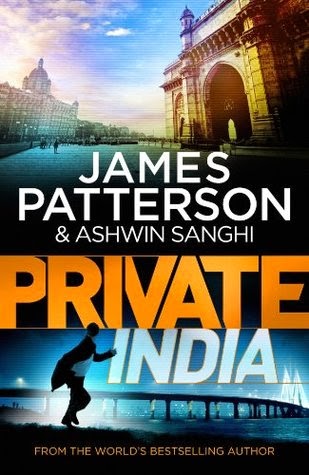
Private India: Collaboration of Patterson and Aswin Sanghi

James Peterson is a paperback mass production unit. I had read his first major novel Along Came a Spider, which was well written and reasonably good murder mystery featuring a troubled detective. These days he brings out variety of paperback bestsellers co-written with several other writers. Aswin Sanghi is an Indian writer specialized in writing mythological thrillers. Now they have collaborated to bring Private India, a murder mystery set in Mumbai. The expectations were very high when two men who know the trade join hands.

The novel starts with the murder of a Thai doctor in Mumbai. Very soon more bodies start piling up. After every murder the dead bodies were arranged in a peculiar manner. Santosh Wagh, Indian head of Private, an investigation agency headed by former CIA Jack Morgan, and his team starts investigation of seemingly unconnected murders. Soon all kind of trouble befell on investigators- corrupt cops, dangerous underworld dons, a Pakistani attempt to annihilate them and above all a smart serial killer who always seems one step ahead.

The winning point of Private India is its incredible pace. I finished the 400 plus paged book in just two sittings. Plot marches on very fast and while reading you tend to ignore most of the flaws. But once we are done with it, the euphoria subside and we look back to it, we realize that what we read was actually a checklist of serial killer clichés. The characters of antagonist and protagonist are done to death. Even the settings and thrills are nothing new. Mythological angle of the murders give some variety to the plot, but even then it is skin deep. Reader never gets a takeaway from it.

Private India is fine for a quick read on a lazy holiday. You will be lightly entertained if the expectations are kept rock bottom.

Friday, October 17, 2014

The Silkworm by Robert Galbraith: Striking Again...

I had read the second novel in Cormoran Strike series by J K Rowling, written under the pseudonym Robert Galbraith, some months back, but only now came to write about it. A delay like this has an advantage, it filters out all the unimportant factors about the book out of the writing. The opinions tend to be more balanced and thought out. Now that everyone are aware who the author is, one novelty of the first novel is worn off. What I expected from The Silk Worm was two things. Some more elaboration of the major characters- Strike and Robin, like how they take their first success and how they grow as characters. Secondly a great story.

Following their success Strike and Robin are now more steadily employed, though most of the cases are quite unchallenging. One day a lady approach him asking to find her missing husband, who turns out to be Owen Quine, an out of luck novelist whose latest manuscript gets leaked. The novel Bombyx Mori, translated as Silk Worm is actually an abusive rant on several people with whom he collaborated in past. During investigation Strike find the dead body of Quine. It is evident that he was murdered in the same way the lead character of the manuscript, who was modelled on himself, is killed. Strike has to identify the killer from seven suspects whom Quine has parodied in the novel. Parallel to this story line, another story is told- Robin is varied of Strike's attempts to limit her to office jobs while she wants do investigation. Robin's suitor's dislike of Strike and her job is another barrier for both of them In functioning as a team.

The mystery is just great. Each and every twist was for me very much unpredictable and convincing. The writer is successful in showing that even literary world, that look quite placid from outside, is not free from petty envies and ego clashes. Colorful characters, all of them, add to the enjoyment of reading it. The manuscript of Quine, which essentially forms the skeleton of the mystery is embedded masterfully to the narrative. Slowly, when the crime unfolds, author changes the mood of the narrative darker.

One unpleasant aspect of The Cuckoo's Calling was the repetition of certain factors in its narrative. In The Silk Worm, the trend made me feel the length of the novel. For example the handicap of Strike was established in the first novel itself. In this novel, every instance he ventures out, a mention about this is made. If he is outside for investigation, he is made to suffer endlessly due to his cripple. Even the places were the tension between Robin and Strike is described, we find the same issue. If these issues weren't there reading this extra long book would've been a cakewalk for me.

Sunday, September 21, 2014

Storm Front by John Sandford: A Disappointment

The reason why I picked a novel by John Sandford to read was certain online reviews by readers who held generally favorable opinion regarding him. Storm Front is a 2013 mystery novel of a series featuring Virgil Flowers, a Minnesota cop. Storm Front is about Flowers' attempts to get back a relic that was stolen by a priest from an archeological site in Israel, who is in quest of a prospective buyer. Creating head ache for Flowers are some conflicting factions who want to buy the relic and put it to use for propaganda.

My first issue with the novel is the leading man himself. Virgil Flowers doesn't sound like a great name for a crime fighter. Neither are his investigating skills impressive. He seems uninterested most of the times. Certain ethical quirks and a goofy humor sense are his only saving graces. Even other characters are more caricatures and does not evoke any emotion- not even hatred, in the reader.

The plot is much convoluted. There is lot of action around, but barely anything happens other than the introduction of another new character every 50 pages. Everyone chases around the whole time, but none seem to convey any urgency. The book was probably intended as a satire, but the blend of humor and mystery was bland. The only reason why I finished reading this one is on and off streaks of humor in the narrative. Its a day since I have read this book and to remember what finally happened to the stone I have to exercise my neurons. So much for the recall value of it.

Tuesday, December 24, 2013

Along Came a Spider by James Patterson: Alex Cross Mystery #1

Along Came a Spider is the first novel by James Patterson featuring Alex Cross. There was a movie based on it starring Morgan Freeeman as the protagonist which I never had a chance to watch. My expectations were a lot from it as Patterson went on to write around twenty more books featuring the Cross.

The novel starts when Cross, a black detective and a doctor of psychology, involve in a murder investigation of a black family. He is furious when he is pulled from it to investigate the kidnapping of two children from high profile families. His adversary is a master criminal, cold blooded, brutal and ready to go to any length for becoming United States' biggest criminal. What folows is a cat and mouse chase were Cross finds every thing that he valued in life at stake, even his sanity.

As the starting book of the series, Along Came a Spider works in establishing the premise and characters. The setting of the novel is Washington DC. On one side there is the posh neighbourhood of affluent movie stars and politicians, while on other side there is the black  neighbourhood where poverty reigns. Cross stands as a bridge between these two contrasting worlds. Though the writer tries to play down the racial undertones of the premise, it shows beneath the surface. In Gary Murphy Alex Cross gets a worthy adversary.

Still there are a few blemishes. The romantic side track makes the story dragging. It is essential to the plot as revealed in the climax, still it dampen the atmosphere of suspence. Also, though Cross is a professional shrink as per the story, we don't find many instances where it is used in the narrative.

Along Came a Spider works ok as a suspence thriller and the character of Alex Cross as a conflicted investigator is worth reading once.