Showing posts with label mystery. Show all posts

Tuesday, July 4, 2023

Book Review: Sherlock Holmes and the Legend of the Great Auk by Linda Stratmann

A stuffed specimen of the great auk, a flightless bird supposed to be extinct, is being unveiled at the British Museum when a young ornithologist tries to vandalise it after accusing it of being a fake. When he is murdered in a fashion similar to how conventionally flightless birds are done away with, Sherlock Holmes is entrusted with three missions: to solve the murder, to prove the legitimacy of the specimen, and to save the museum and the late contributor of the specimen from further scandals.


Whenever any attempt is made to bring out a new novel or movie from a known franchise, there arise certain expectations that are built up from the previous experiences associated with it. If the new product fits the template, it is, personally, a satisfactory experience for me. If it alters the franchise in a great way that radically changes our attitude towards it, like how Christopher Nolan transformed the cinematic landscape of Batman movies, I am delighted. But if the retelling tries to subvert my expectations and spoil my goodwill towards the franchise, it will be a horrible disappointment. I had my fingers burned with Sherlock Holmes once before by reading The Curious Case of 221B by Partha Basu.

Thus, it was with a certain curiosity about how it would turn out that I started reading Sherlock Holmes and the Legend of the Great Auk, which was provided by Netgalley and the publisher in exchange for an honest review. It is written by Linda Stratmann and is the fifth installment of the series The Early Casebooks of Sherlock Holmes. The novel chronicles the mysteries solved by Holmes in his pre-Watson period, while he was a student doing rather dangerous chemical experiments and accumulating different skills and knowledge required for his celebrated and distinguished future career.

As this is the fifth book in the Early Casebook series, the character is properly established in this universe. Linda Stratmann doesn't deviate much from the template set by Conan Doyle. The character of Holmes displays all the quirks and eccentricities that are made famous by the classic stories. The author has toned down a lot of his tendencies towards substance abuse. It is evident that Stratmann has a good understanding of the historical mapping of the times and the literary style of Doyle. The language she uses is thankfully very similar to that of Doyle and suitable for the story. The plot is intriguing, with many threads of mysterious incidents overlapping one another.

The story is narrated by Mr. Stamford, a student of surgery who is also Stratmann's stand-in for Dr. Watson. There is nothing to complain about the character, but while I would appreciate that Stratmann chose to stay as close to Doyle in other aspects, a slight variation in this character, who very much resembles Dr. Watson, would have taken the novel to a higher level. It is evident that Stamford narrates his adventures with Holmes at a later period, long after Watson has already published his stories with Holmes. This setup is excellent, as it leaves room for a lot of references to the plots of various classic Holmes mysteries. It will also be interesting to explore the motivation behind Stamford's recounting of these old accounts so late in life. Was it a late attempt to grab fame and limelight when Watson has already achieved them? Does this attempt compromise his storytelling in any way? Some interesting details to ponder about

Stratmann has used several real-life figures and incidents in the novel, which became evident to me only after reading the final notes. This also became a factor that I appreciated about the book, as it added an additional layer to it. The plight of the great auks and the final extinction of the flightless, monogamous, penguin-like species are heartbreaking. Though the author doesn't explicitly express it in the book, ecological conservation manages to come out as a major takeaway. An envelope of humor—a tad more than that can be found in the works of Doyle—covers the Legend of the Great Auk.

Linda Stratmann has delivered a suspenseful detective novel featuring Holmes, very much in the style of Doyle. Though this Holmes never attempts to break any new ground and settles to stay close to its classic predecessor, the book ultimately was a satisfying experience.

Friday, May 29, 2015

In A Cat's Eye by Kevin Bergeron

Willy finds Nancy, the girl he fancies, dead in her room in Hotel Morpheum one day. He too stays in the same hotel. Willy is a misfit- jobless, an ex-convict, totally lacking in social skills, living in his own world and highly volatile. He never pays his rent, but the landlady keeps him there as he is good with tools and comes handy. Police and other lodgers believe Nancy had overdosed on cocaine, but Willy is dead sure she was murdered. He knows that because her favorite statue is missing from her room. 

Willy also knows that Mr. Winkley- her one-eyed cat is the sole witness of the crime. He takes in the cat and embarks on a journey to find the killer; knowing that finding the missing statue is the key to it. The line of suspects is long and in the end of it stands Willy himself- he has the tendency to forget things that he did. He has a vision of the killer in the cat’s eye, but how will he reach to that person? And who is going to believe him?

In a Cat’s Eye is the debut novel of Kevin Bergeron, published by Authonomy, an online community for budding writers, developed by HarperCollins. It is a short novel, slightly longer than a novella. The story is narrated in first person, through the eyes of Willy. It is essentially a detective novel, though the detective in this story lacks most of the basic qualities assigned to one conventionally in the genre. 

Willy is an unreliable narrator and it is this quality that makes the novel distinguished. There is an ambiguity that surrounds his rants, which should alienate the reader after a point of time. But here it doesn’t happen. I was drawn into the story and started rooting for him in a very subtle way as it progressed.  All the other characters in the hotel are nutcases and equally unsociable. All of them seem possible murderers. This motley crew of suspects adds uncertainty and vibrancy to the plot. Only the all-knowing one-eyed cat is the sane being.  

One more aspect that I liked about the plot is the kind of unveiling effect that it has on the reader. The background of the story is provided in bits and pieces and as the narration progresses, the picture becomes clearer and clearer. It adds to the suspense.  The weak point of the novel, for me, was the lack of flesh in it- non-existence of detailing. I love descriptive novels. But considering the protagonist’s condition, it has to be excused.  To sum it up, In a Cat’s Eye is an engaging novel, that never overstay its welcome.

Buy the book :

Saturday, May 16, 2015

The Baklava Club by Jason Goodwin

These days it seems I am reading only detective stories! Even the novel by Mario Vargas Llosa (about which I may blog soon) that I read recently was sort of a mystery. But I absolutely love the variety in geography, history, plots and structure that these novels displayed. The latest one that I received as an eBook from netgalley.com, on which this post is about, is no different. The Baklava Club is a novel set in 1840’s Istanbul under Ottoman rule and has its protagonist an influent eunuch named Yashim, who is quiet fluent in the intricacies of both Turk and Western culture. It is the latest in a series of historical mystery novels penned by Jason Goodwin featuring Yashim.

The Baklava Club is the name given to four Italian rebels in exile by the good natured Polish Ambassador of Turkey, Palewski. Palewski, a good friend of Yashim, is planning a meeting between a secret person and the Sultan, which he believes has the potential to regain the lost glory of Poland and change the political landscape of Europe. Along with the Italians and Polish, Istanbul sees an influx of several Europeans, at least some of them with dubious intentions. When the Ambassador is shot and his secret man is kidnapped, Yashim has to step into the quagmire. The brutal murder of a beautiful European girl complicates the matters. 

The Baklava Club is a short book and a fast read. I finished it in a single sitting. The novel moves slowly initially, very cleverly setting the scene for the central crime and once it happens, abruptly changes gears. Though each of the characters, including Yashim, seems petty, clichéd and shallow when introduced, by the end of the book surprisingly each of them makes an impression in the reader’s mind. Particularly noteworthy is the depiction of the moment describing Yashim’s personal involvement in the affair. Inclusion of it comes as a shock and is a brave decision from the author’s side. Along with providing the thrills, the novel discusses, very lightly though, the theme of being away from one’s home- the many kinds of exiles that is imposed on one, by oneself or by society. It ascertains that one can be in exile even while living in one’s own country and that kind is the most painful.            

Thursday, April 2, 2015

The Veteran by Forsyth: Quick Shorts

I have found Frederick Forsyth novels consistently enjoyable. The deep research that evidently went behind each of his books gives the stories much credibility. Also the way he mixes facts and fiction is commendable. The background information-trivia- that he provide for the readers in many novels are fascinating. That was the reason when I saw that The Veteran was a collection of five novellas, I was a bit turned off. I was worried that the short story/novella format may not suit Forsyth's elaborate style of narrating stories.

The Veteran, the opening story is a police procedural. It starts with the mugging and killing of an unidentified man and the police arresting two criminals, thanks to a sound witness and solid proofs. But a very successful attorney appears for the convicts and causes their acquittal, only to ensure that natural justice prevail. Breakneck speed is the only thing that keeps our interest in the story. The twist ending was predictable, but satisfying.

Art of The Matter is a heist story set in an auction house that deals with paintings. When he loses his job due to a fraud committed by his superior, an ex-employee decides to take revenge by teaming up with an out of work actor, another victim of fraud. This one is my favorite due to the elaborate setting of the plot and detailing. Suspense element does not play much of a role.

In the third story, titled The Miracle, an American tourist couple in Sienna meet a stranger who tell them a mesmerizing story of a miracle that happened right there during the Second World War. Though in the end the story turns out much simple than anticipated, that makes the twist more enjoyable. Point to note is the mastery displayed in narrating the story. I could visualize the entire happening.

In the fourth story, titled The Citizen, the author really falters. It is about international drug trafficking through commercial airlines. The plot tries to be too clever and the climax tries to be manipulative. This resulted in an unsatisfactory ending.

The fifth novella, Whispering Wind is the longest of all. Here an American scout in Montana loves a Cheyenne girl in 1850s, but she gets married to someone in her community. The man wakes up in the next century and after facing much hardships, gets successful in getting back the love of his life. The narration of this story is top notch and that helped me to adjust with the sudden shift to fantasy.

Forsyth is successful in assembling a bunch of stories displaying an astonishing range. Plotting is great. Pacing is frantic to say the least. Narration is fantastic. The forced twist endings doesn't work in some stories. Characterization is totally lacking. Overall, keep the expectations a bit low and here is your perfect holiday read.

Sunday, October 19, 2014

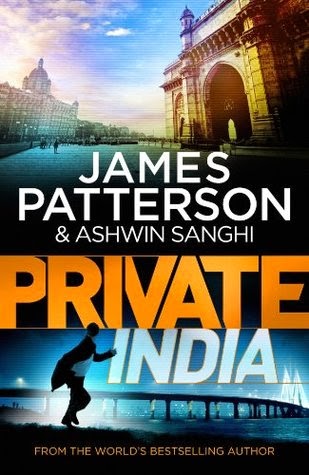
Private India: Collaboration of Patterson and Aswin Sanghi

James Peterson is a paperback mass production unit. I had read his first major novel Along Came a Spider, which was well written and reasonably good murder mystery featuring a troubled detective. These days he brings out variety of paperback bestsellers co-written with several other writers. Aswin Sanghi is an Indian writer specialized in writing mythological thrillers. Now they have collaborated to bring Private India, a murder mystery set in Mumbai. The expectations were very high when two men who know the trade join hands.

The novel starts with the murder of a Thai doctor in Mumbai. Very soon more bodies start piling up. After every murder the dead bodies were arranged in a peculiar manner. Santosh Wagh, Indian head of Private, an investigation agency headed by former CIA Jack Morgan, and his team starts investigation of seemingly unconnected murders. Soon all kind of trouble befell on investigators- corrupt cops, dangerous underworld dons, a Pakistani attempt to annihilate them and above all a smart serial killer who always seems one step ahead.

The winning point of Private India is its incredible pace. I finished the 400 plus paged book in just two sittings. Plot marches on very fast and while reading you tend to ignore most of the flaws. But once we are done with it, the euphoria subside and we look back to it, we realize that what we read was actually a checklist of serial killer clichés. The characters of antagonist and protagonist are done to death. Even the settings and thrills are nothing new. Mythological angle of the murders give some variety to the plot, but even then it is skin deep. Reader never gets a takeaway from it.

Private India is fine for a quick read on a lazy holiday. You will be lightly entertained if the expectations are kept rock bottom.

Friday, October 17, 2014

The Silkworm by Robert Galbraith: Striking Again...

I had read the second novel in Cormoran Strike series by J K Rowling, written under the pseudonym Robert Galbraith, some months back, but only now came to write about it. A delay like this has an advantage, it filters out all the unimportant factors about the book out of the writing. The opinions tend to be more balanced and thought out. Now that everyone are aware who the author is, one novelty of the first novel is worn off. What I expected from The Silk Worm was two things. Some more elaboration of the major characters- Strike and Robin, like how they take their first success and how they grow as characters. Secondly a great story.

Following their success Strike and Robin are now more steadily employed, though most of the cases are quite unchallenging. One day a lady approach him asking to find her missing husband, who turns out to be Owen Quine, an out of luck novelist whose latest manuscript gets leaked. The novel Bombyx Mori, translated as Silk Worm is actually an abusive rant on several people with whom he collaborated in past. During investigation Strike find the dead body of Quine. It is evident that he was murdered in the same way the lead character of the manuscript, who was modelled on himself, is killed. Strike has to identify the killer from seven suspects whom Quine has parodied in the novel. Parallel to this story line, another story is told- Robin is varied of Strike's attempts to limit her to office jobs while she wants do investigation. Robin's suitor's dislike of Strike and her job is another barrier for both of them In functioning as a team.

The mystery is just great. Each and every twist was for me very much unpredictable and convincing. The writer is successful in showing that even literary world, that look quite placid from outside, is not free from petty envies and ego clashes. Colorful characters, all of them, add to the enjoyment of reading it. The manuscript of Quine, which essentially forms the skeleton of the mystery is embedded masterfully to the narrative. Slowly, when the crime unfolds, author changes the mood of the narrative darker.

One unpleasant aspect of The Cuckoo's Calling was the repetition of certain factors in its narrative. In The Silk Worm, the trend made me feel the length of the novel. For example the handicap of Strike was established in the first novel itself. In this novel, every instance he ventures out, a mention about this is made. If he is outside for investigation, he is made to suffer endlessly due to his cripple. Even the places were the tension between Robin and Strike is described, we find the same issue. If these issues weren't there reading this extra long book would've been a cakewalk for me.