Tuesday, September 25, 2012

Book Review: The Krishna Key


The Krishna Key by Ashwin Sanghi falls in the category of conspiracy theory fiction. The fact that it has to compete with such giants like Faucault’s Pendulum or Da Vinci Code makes the task of the writer difficult. But Sanghi has already proven his mettle in story telling with already a best seller Chanakya’s Chant in his credit. Thus the expectation from this novel is sky high. As the name indicates, the novel is an adrenalin ride based on the life of Krishna, the most enigmatic character in Indian mythology. It reads in between the lines of Mahabharatha, Bhagavatha and many other ancient scriptures and tries to tell a story of treasure hunters whose fate lies on solving the clues provided in them.  
The biggest issue with Indian history is its ambiguity. Our ancient history is never recorded in a factorial manner like Greek or Roman history. There are only loose versions of events and personalities spread over many epics, scriptures and folklores. Many incidents are exaggerated, many are subdued and most are allegorized thus leaving many black holes in the narrative. Half baked and prejudiced historic studies in Colonial times also worsened the ambiguity. This gives ample scope for writers to reinterpret the events and form conspiracy theories. Sanghi uses this to his advantage by using up almost all the conspiracy theories related to Indian mythology in his narrative.
A man claiming to be Kalki Avataar, the last of ten incarnations of Lord Vishnu, is on a killing spree. A Professor with expertise in Ancient Indian History is framed for the crimes. His only chance of survival now lies in solving a mystery from past. Along with him or against him in the rat race are some curious personalities with motives of their own- greed, love, loyalty, revenge and piety. An underworld don with a curious lineage, a stubborn lady police officer, a corrupt CBI officer who will do anything for money, a criminal lawyer and so on… Lead by Saini gathering clues from Indian mythology and History, they are on a dangerous journey to uncover a secret from past that can render every modern technology obsolete.
The Krishna Key uses every conspiracy theory and controversial historical theories perpetrated in the subcontinent to prove its point. In Umberto Eco’s novel Faucault’s Pendulum there is a very interesting observation about conspiracy theories. It is very easy to make a connection between too seemingly unconnected events if one has a superficial but wide knowledge and good imagination. In that novel some men starts making a new conspiracy theory for fun and it goes out of their hands, finally they themselves believing the lies. Here too this complex is evident. Every bit of historical information, however farfetched it may seem, is made to bear a connection to Krishna. I am not making this point to demean the work of its immense readability, because in this genre, this quality is a must to make the novel interesting.

The Krishna Key as I have told is very readable thanks to the fast pace, clever plot twists and diverse information thrown at the reader in regular intervals bewildering them. One negative point about the narration is its lack of good characterization. One does not feel a bit for Saini or any other character however deep distress they are in. But this deficiency is mostly covered up by the ambiance that Krishna Key creates in reader’s mind. It takes us into several mystery- laden and exotic places in the subcontinent. I would definitely suggest this novel to people who loves page turners.  


This review is a part of the Book Reviews Program at BlogAdda.com. Participate now to get free books!

Sunday, September 2, 2012

Acidic Wit: Stories by Saki (H H Munroe)

Saki is one writer who brings back memories of High School English classes- memories of several teachers with their different styles and methodologies, different (mis)pronunciations, mannerisms and different levels of interest they evoke. Saki or H. H. Munro was a regular story writer featuring every year in our English text books. Also if we take any anthology of English short stories, one story by him is a must. So when I saw a collection of Complete Short Stories I grabbed it eagerly and devoured it. 

The book contains stories from five of his collections. The first two Reginald and Reginald In Russia, features his famous character Reginald. He is a young guy, outspoken and infatuated with his own good looks. Theme of all these stories is his unfruitful and embarrassing (for others around him) social interactions. Third collection, The Chronicles of Clovis features Clovis Sangrail, another clever youngster always making elaborate practical jokes much to the discomfort of other civilized beings of society around him. The Beasts and Super Beasts is a collection that involves stories concerning nature. Other two collections – The Toys of Peace and The Square Egg are his early works and stories published posthumously. The stories are readable though comes nowhere near stories from other collections.

Just like many other story writers of his time, the stories by Saki are predominantly humorous. He satirizes the social structure of his times. What makes his stories different from his contemporaries is his scant regard to political correctness and absence of any contempt to his characters. Most of thestories are of pranks played by someone onan unsuspecting victim and in most of the cases the fun causes some sort of permanent damage tothe victim. We never see any poetic justice happening in them. The satire is acidic. Saki makes fun of the pompous upper class, aspiring middle class and struggling lower class alike. These stories thus make a striking social commentary of his times and also to some extent, of ours.

Saturday, August 4, 2012

Weekend With The Wimpy Kid

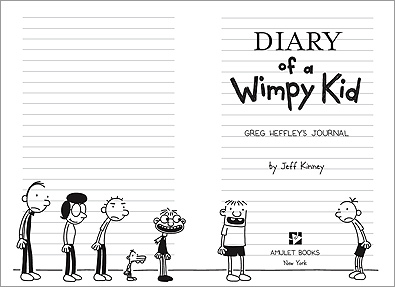
I read Diary of a Wimpy Kid last weekend! It is the unlikeliest of the books that I pick for a reading, but I ended up reading it and that too in a single sitting with a 10 minute nap in between. The kid whom the book belonged to was seemingly shocked when I picked it and told me plainly it was not recommended for me as it was the tale of a naughty boy. May be she thought the story of a mischievous and selfish kid plotting against his friends and doing bad things will adversely affect me. But she doesn’t know that the damage is already done! She recommended another book for kids were a rat and his friends run a newspaper and do incredible things. As I could not get past the second page, I returned back to the wimpy kid. Sunday evenings are not to be spent with rats, however intelligent they may be.

When you read a bookprimarily meant for entertaining kids and you are of an age past30, it is tough to keep the inhibitions aside. You are dispassionate,not feeling much of anaffection to the built up and you go on looking for loop holes.And then I took the nap that I mentioned before. Do you know apeculiar thing? After taking a nap in a Sunday afternoon, your skill to appreciatethings takes a beating.I remember a couple of weeks back, a Sunday afternoon I slept and woke up to find a Mithun Chakaraborthy movie playing in TV. I watched it full and even felt it was ok. I don’t know if this is ever verified scientifically, but ultimately I enjoyed the book.

Diary Of A Wimpy Kid is written by Jeff Kinney. Wimpy kid is Greg Heffley and the book is written as a diary with funny illustrations and caricatures depicting his struggles in middleschool. He wants to become the most popular kid and everything that he does for achieving it backfires. The book is really funny and will appeal to kids most. Even adults will find the story amusing. I love the parts about Cheese touch, becauseas kids we used to have that concept. If any one of us touches anything dirty, no one touches him. He can transfer the curse by just touching another kid. If you are an adultand happen to like this book, I will recommend two morebooks to you- “Tottochan, the little girl by the window” and “The Little Prince”.

Thursday, August 2, 2012

Yathicharya: A Spiritual Journey

In Malayalam, there are many writers whom I really adore. But the one writer- doesn’t know if I can call him that as he is much more than a mere writer, who has really inspired me, is Guru Nityachaitanya Yathi. One of my close friends, an avid book lover as me, recommended his books to me and a skeptical me opened his book “Soundaryam, Anubhavam, Anubhooti” expecting a very spiritual kind of book. It was an experience! After reading it, I came to know how to read a book, how to look at art, at life and at world with an open eye, not to just see it, but to feel, understand and make it an experience as the title of the book suggests. His writing style is so passionate about life and art and so simple that you cannot help feeling a strange attraction towards the subject that he writes about. And talking about subjects, he writes with same passion and in depth about Poetry, fiction, philosophy, psychology, religion, society, people and many other topics. His (incomplete) translation of the autobiography of Neruda is one of the best Malayalam translations that I ever read. You cannot believe that a Sanyasi can translate love, passion and anger felt by the rebel poet and make the reader empathize with him.

“Yathicharya” is his travelogue on one of his visits to Europe and US. This book, I feel can serve as a good introduction if you are interested to read more of his books because essence of his philosophy, his interests and his vision can be seen here. His interactions and discussions with the friends, experts in various fields and totalstrangers constitute most of the narration. You will not find many descriptions about the places that he saw. Only those things that interest him are detailed. But the book is in no way boring as Guru does a good and interesting character sketching of every one whom he has met. A healthy dose of humor surprisingly garnishes otherwise serious proceedings. There are lots of pages devoted to thoughts of death. May be the reason is his failing health and the news of the death of some his near ones.

Wednesday, July 25, 2012

The Warrior: A Journey to Higher Realms

The Warrior is a British movie made byAsif Kapadia, a director of Indian origin. This movie, set in India is his first feature film and had a crew of diverse nationalities. The movie was appreciated all over and was the official entry for Academy awards from UK that year, but was rejected as the dialogues were in Hindi, a language that is not indigenous to UK. The Warrior catapulted Irrfan Khan, who had appeared in minor roles and in TV serials till then into international fame.

The Warrior, set in medieval India, is the story about the redemption of a brutaland remorseless warrior working for a cruel landlord in Rajasthan. Warrior hasa son whom he wantsto mold like himself. But the son is not interested and is of a more compassionate and passive nature. Once while raiding a village, the warrior happens to point his sword to the neck of ayoung girl and has a vision of him on a snow clad mountain. The vision causes an abrupt paradigm change in him and he decides to abandon violence. He decides togo to the mountains that he saw in the vision and lead a peaceful life. But the landlord and his colleagues are not ready to let him desertthem. His son dies trying to save his life. He embarks on the journey alone. Rest of the movie shows his journey and struggles,the people he encounters on the way, the changes theymake in him and his violent past catching up with him in the end.

This is a perfect example of how with limited resources, a movie with an epic feel can be made. Many actors are local people and first timers, the sets are actual ruins and villages in remote areas of Rajasthan and more importance is given for character development and story-telling. With a story based on the theme of violence, there was lot of chance to portray graphic onscreen gore. But the director cleverly avoids it and concentrating more on the emotional core of the story. Even the most violent scenes- a decapitation and many killings are shown out of screen with just the expressions of actors revealing the ferocity of incidents. Irrfan, with his expressive eyes does a fabulous job in revealing the troubled inside of a changed man. All the other supporting actors also does a great job, even those in bit parts.

I love movies that make me to think. I always feel there should be another layer below what is revealed to the audience, something that makes him connect the story withhis life. The Warrior is such a multi layered movie. I feel this movie is about going the right way. It beautifully portrays the hardships that a man has to endure if he chooses the right path. Everything turns back against him, he loses his loved ones, his colleagues are out for his blood and in every crossroad he has to reconsider his decision, in a dilemma,whether he has done the right thing. But in end things always gets fine. The journey from the barren lowlands of Rajasthan to upper mountains ofKulu, is essentially a spiritual journey to higher realms.