Friday, March 31, 2023

Book Review: South by Babak Lakghomi


 In an unnamed totalitarian nation, freelance journalist B is travelling through a dilapidated desert. His mission is to report on the worker's strike on an oil rig located at the southern part of the country. He believes that the journey will provide him an answer to everything, including his troubled past. Inspite of a warning from the people of wind to beware of the South winds, he reaches the oil rig and tries to interview the workers. But little does he anticipate the whirlpool of manipulation and censorship that drowns him into depths of desperation. 

South, a short novel written by Iranian-American writer Babak Lakghomi, is a strong depiction of our present political landscape that is deceptive and manipulative. Its protagonist B is a man who is punished for his attempt to look back into his past. The state that ruthlessly suppress even a personal quest that may go against its interest stands tall as the unnamed antagonist, who never appears, but permeates every word of the story. 

The story is told in the first person narrative of B. There are also some snippets from The Book of The Winds, a book B brought with him on the journey, some pages of his father's diary and his own notes (some of which he himself never remember writing). It is evident that B is a classic unreliable narrator and struggles to maintain clarity to his line of thoughts. He faces adversities in a defeatist mood and springs back into his own cocoon every time he faces a defeat. 

The narrative structure of the novel is also non linear, hallucinatory and chaotic. We find ourselves to be an unanchored sailboat in a stormy sea while reading it. There is a certain Kafkaesque element to the plight of B, where whatever he does fails to impact the plot in any significant way and the more he struggles, the more he is pulled into the epicenter of the whirlpool. Background of the desert people, their belief in the people of wind and their indecipherable dialects adds to the turbulence of the plot. 

South is a haunting tale of systematic suppression and manipulation of an individual by a tyrannical regime. It refuses to resolve any questions that it puts forward. It very convincingly portray the inability to make comprehend a subjective truth when the corrupt system itself is working to topple the very notion of it. 

This book is an advance reading copy received from Netgalley in exchange of an honest review. 

Thursday, March 30, 2023

The Mystery Of A Cat In The Box In An Uncertain Universe


Newton fathered physics as we know it now. He formulated precise laws that govern our world, which stood the test of time for centuries. But as our knowledge about the universe incrementally advanced and as we began to deal with scales (both incredibly minute and infinitely large) that were unthinkable at his times, we started redefining the laws. Albert Einstein postulated Special and General theory of relativity that helped us in dealing with the vastness of our ever expanding universe. Quantum physics did the same for the micro universe constituting of sub atomic particles. 

Though I had studied some quantum physics during school, the first time I thought seriously about its implications was during a long train ride when I read a book by Deepak Chopra. The book (I cannot recall it's name, fortunately) was the usual motivational self-help trash, that everyone ends up reading at a certain phase of their life. It married quantum theory with some spiritual mumbo-jumbo and produced a concoction of pseudoscientific rubble. The one and only positive outcome it produced in me was an interest to read more about quantum physics. (I am now curious to know what happened to the me in an alternate universe who tried to realise his true potential through quantum spirituality after believing Deepak Chopra). 

John Gribbin

In his book In Search Of Schrodinger's Cat: Quantum Physics And Reality, John Gribbin tries to make sense of the bizzare world of probabilities, uncertainties, ghost electrons, multiverses and time travel- concepts that are difficult for humans to even visualise. He starts from basics by introducing the concept of light as particles and waves, atomic structure and the weird inconsistencies that necessitated a new method of looking beyond our perceived reality. The book chronicles the evolution of quantum theory through the inputs from several ingenious minds that braved to think in radically different ways. 

The best thing about the writing of Gribbin is his explanation of complex and out of the world concepts in a manner that anyone with an interest can easily comprehend. Though the subject is very difficult to visualise and is heavily dependant on complex mathematical equations to make its points, Gribbin very patiently lead us on our way to understand the working of a world that thrives on uncertain resolutions. I loved the way he connects tough quantum concepts with easily understandable local situations and explains them. 


It is disheartening to know that quantum physics makes the universe unpredictable and dependant on chances and probability. The rigid frame work of Newtonian thought and the causal hierarchy of Einstein's findings turned out to be limited. Working of the building blocks of our universe doesn't work predictably. It is difficult to unlearn a lifetime's knowledge and accept a contrarian worldview. But the quantum cookbook has been an integral part of human development- super computers, nuclear reactors, microchips and lasers are all some of its most common practical applications. On the top, it is equally mind blowing to realise that quantum physics may open the door to more exciting prospects like multiverse and time travel. A basic knowledge of the quantum reality is essential for all and this book is a very good entry point for that. 

"The atoms in my body are made of particles that once jostled in close proximity in the cosmic fireball with particles that are now part of a distant star, and particles that form the body of some living creature on some distant, undiscovered planet. Indeed, the particles that make up my body once jostled in close proximity and interacted with the particles that now make up your body."


Thursday, March 23, 2023

Algorithmic Approach To Human Decision Making

One of the most important and crucial element of our life is inarguably decision making. It is a process that we all perform incessantly with varying outcomes. From the most trivial decisions like which Netflix series to binge watch, to the most existential ones like what is the right occasion to deploy a nuclear weapon, decisions decide the quality of our individual and collective being.


Algorithms To Live By: The Computer Science Of Human Decisions is a book written by Brian Christian and Tom Griffiths, that tries to compare human decision making with algorithms developed by engineers for the efficient running of computer systems. The books points out several daily life cases where algorithmic logic can be employed for decision making. Algorithms are basically a series of steps that solve a problem, which is what we do in our life too, sometimes consciously, like when we assemble a furniture using instructions or many times unconsciously, like when we plan a shopping trip across multiple shops.


The book is divided into 11 chapters, and in each one, authors demonstrate how a specific type of algorithm can be logically used to solve certain problems that are encountered in life. The book also details the evolution of these algorithms and surprisingly most of them are tweaked from solutions existing mathematical puzzles. In some cases, human mind follows the same logic unconsciously  to reach the solution by itself.
It is also important to note that, most of the algorithms are not mathematical formulas, which once applied lead us to a perfect solution. Application of algorithmic logic doesn't lead us to the best decision, but it can show us the one solution that has best probability to be perfect.
For example, if you want to find a rental place in a month's time, 'optimal stopping' algorithm will suggest a look/leap approach. You start looking and apprising all the apartments without selecting any for a period of time and then going for a leap and selecting the next best that comes your way. Your looking period should be 37% of the total time you have to maintain the probability to get the best possible apartment for you.


Likewise consider that you are in a new town for a period of one month and you have to eat in restaurants for the whole period. Would you explore as many restaurants as possible in a month, or will you settle for the first good one after finding it by exploring for it. Algorithmic approach of explore/exploit logic would be to explore initially and once your departure from the town is near, go for the best ones that you find by exploring and exploit them. Another intersting example for this approach is Hollywood, which explored many types of movie making for decades and now when it perceive its end, started exploiting all that it explored by making sequels, reboots and spin-offs.

 
Apart from these approaches, other chapters deals with human activities of sorting, caching, scheduling, communicating and dealing with other persons. I loved the chapter on using game theory to maximise mutual benefitting from human interactions. One important concept to clearly comprehend while using these techniques is that none of these are instant fixes. Applying algorithmic logic to real world problems will result only in the best probable result. Using it consistently over longer periods of time will better the probability to get the best solutions.In the author's own words:

...the best algorithms are all about doing what makes the most sense in the least amount of time, which by no means involves giving careful consideration to every factor and pursuing every computation to the end. Life is just too complicated for that.

Sunday, March 19, 2023

Two Graphic Novels by Michel Kichka

 Michel Kichka is a left leaning Israeli cartoonist. I happened to read two of his autobiographical works that are published as graphic novels- Second Generation and Falafel With Hot Sauce. Second generation is a book about his relationship with his father who is a Holocaust survivor. Falafel With Hot Sauce is about his relationship with Israel to which he immigrated from Belgium. 


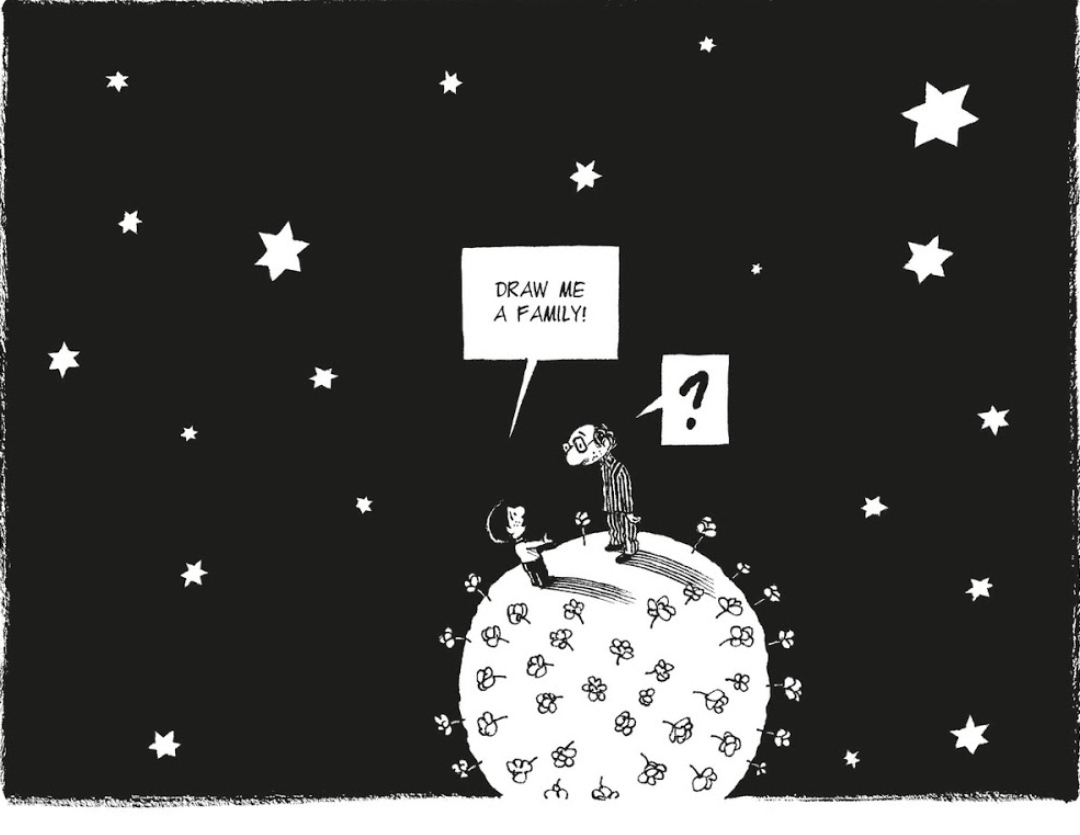
Kichka decided to produce Second Generation after reading Maus, another impressive autobiographical graphic novel in which Art Spiegelman wrote about his father, also a survivor. While in Maus, Spiegelman narrates the experiences of his father in the concentration camp, Kichka tries to ruminate on the effects of his father's experience on him and his family. 

Michel's father never talked to him about his past- how his entire family, except him was wiped out and how he survived inhuman atrocities of the Third Reich. Michel figured most of it himself, by reading his father's collection of books, from his caricatures that he drew and his many idiosyncrasies and rants about his sufferings that were tolerated because he was 'in the camps'. I believe all his attempts to identify with his father took him closer to his Jewish identity. 


Henri Kichka, father of Michel Kichka

After immigrating to Israel and starting his own family there, one day Michel wakes up to hear the news of his brother Charly's suicide. After that his father opens up about his experiences and soon becomes a public figure, doing talks and writing books on his experiences. Michel feels his brother was the victim of Second Generation Syndrome and feels his father's behavior has shifted the focus from Charly. From a belated letter from Charly, he infers that unhappy childhood was one reason for his death. Slowly over time he mends his relationship with his father, promising to visit Auschwitz with him. 

It is interesting to note that the book that starts on a dinner table ends in another one. Most of the major happenings in the novel are around dining tables were the mood alternates. But it is assuring to see the last one that emit acceptance and compassion. Second Generation is a very sensible portrayal of a delicate relationship. It never falls into the trap of sentimentality or sensationalism. Drawn fully in black and white, the narration, interspersed with a sprinkling of humor, is very tight and poignant. 

We see a young Michel tasting a helping of Falafel with hot sauce on his first vacation to Israel in the opening pages of his second graphic novel, aptly titled as Falafel With Hot Sauce. At that moment, he learns his first lesson- 'In Israel, what you see isn't always what you get'. The book builds up on this lesson and chronicles his bittersweet relationship with Israel. 

Michel grew up in Belgium according to Jewish tradition. After his visits to Israel and identifying with its struggle to stand up and walk, he decides to drop out of his architecture degree and immigrate. He pursues a degree of art in Jerusalem. In an Israel, which was fastly turning to a far right ideology, he decides to stay a left leaning cartoonists. The first half of the book is details of his integration into the country and second half features his rebellion as a leftist cartoonist. But finally he asserts his love for his country and how his attempts for peace are born out of that love. 


Falafel With Hot Sauce is more dynamic and far reaching in its political scope when compared to the more personal Second Generation. But Michel Kichka keeps the narration very much rooted to the humane aspect of life. Irony of the valuable lesson after his first Falafel is explored in several angles throughout the book- in his social interactions, his personal life and also his political assertions through his cartoons. He chronicles his tryst with the history of Israel in a deeply affectionate, though strictly honest manner. 

Michel Kichka


Thursday, March 16, 2023

Book Review: Dead of Winter by Darcy Coates

Christa hoped that a vacation on the snowy Rocky Mountains with her boyfriend may put the ghosts of her past to rest. When her boyfriend goes missing in a snowstorm, she is forced to take refuge in a remote cabin along with total strangers, waiting for the raging storm to subside and for an elusive rescue mission. But heads start popping and when she realise that one among her cabin mates is a serial murderer, she has to decide whom to trust before the worst happens. 

Dead Of Winter is an upcoming thriller novel by best selling writer Darcey Coates, which I got an opportunity to read, thanks to an advance copy by the publisher through Netgalley in exchange of an honest review. I am reading Coates for the first time. The book is a locked door suspense mystery with cabin in the wood kind of horror elements heavily thrown in. 

Story is narrated in the first person perspective of Christa. The narrative style of Coates puts the reader in the midst of the events. While reading through the eyes of Christa, we are aware of only that which she knows about. At the same time we are part of all the paranoia and anguish that she feels. This made me as a reader, more immersed and invested in her perilous journey. 

Ever prevalent suspense is the biggest asset of the novel. The writer has ensured that there are no dull moments in the plot by keeping it thriving and eventful. Right from the opening chapter, the book pulls the reader into its maze. The terror and paranoia that inhabits every character and the atmosphere of uncertainty and confusion that prevails in every page are sufficient to hook the reader. As bonus there are enough gore and jump scares thrown in to spice up the story. Constant presence of a merciless nature- never ending snowstorm and ice clad mountains that hinders every effort of the characters, disallowing any respite also serves as an antagonist in the tale. 

I have read many suspense thrillers that pull rabbits out of thin air. But the best ones always take care to stud sufficient clues (and of course some misdirections also) in the narrative for the more adventurous reader to pick on their way and attempt to decipher the final reveal. The credibility of a fine suspense writer, according to me, lies in making their reader feel 'why didn't I think of it' instead of 'I didn't see that coming'. Dead of Winter made me regret all the missed clues that I ignored, though to my credit, I was able to crack atleast a crucial one. 

In any locked door thrillers, it is crucial to have interesting characters because most of the thrills happens by the suspicious interaction among these characters. My singular objection with the novel is the lack of riveting characters other than the protagonist. All other characters where mostly one-note kind, and serves only the purpose of carrying the plot forward. More meaningful and complex interactions among them would have added layers to the book and whetted the appetite of serious readers who are interested in something more than a racy ride. 

Dead Of Winter is ideal for a reader who wants to read a relentless, atmospheric suspense thriller that features some gore. It is an easily readable book, with a complex protagonist who shoulders the plot effortlessly and a dense atmosphere saturated with paranoia. The novel will be published on 11th July 2023.